

Cheezborger
Sam Sianis, the Billy Goat, and What a Diner Could Be

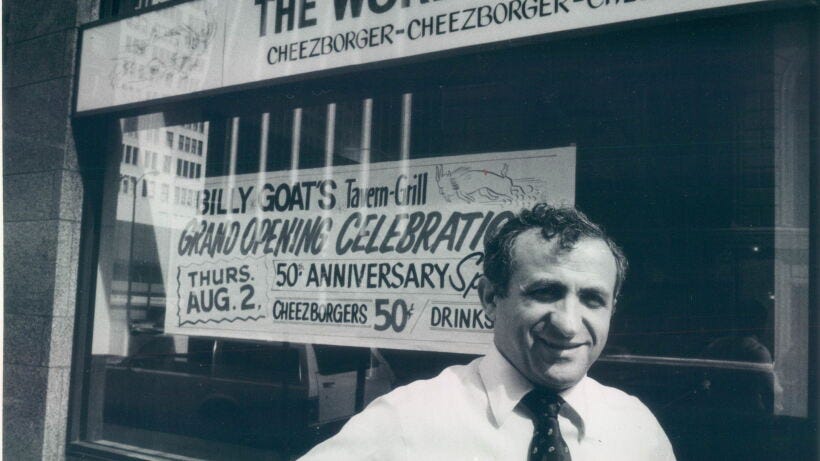
Image: Sam Sianis outside the Billy Goat Tavern, 50th Anniversary, 1984. Photo Credit: Sun-Times File as retrieved from WBEZ obituary on 15 May 2026.
My father had two bits he recycled endlessly. The first was a series of (really bad) Dad Jokes delivered with too much confidence and a thick Greek accent. The second was the “cheeseburger line,” where he’d chirp, again with confidence, again in his Greek accent, “Cheezborger! Cheezborger! No fries, cheeps!” He’d say it at the counter, say it in the kitchen, say it to customers who’d heard it a hundred times and laughed anyway. For Greeks of his generation, John Belushi’s SNL sketch wasn’t just a comedy bit: it was recognition. Like watching Dukakis run for president, it was proof that something of theirs had made it into the American imagination, however sideways.
The sketch, of course, was based on the Billy Goat Tavern. And for 50 years, the Billy Goat Tavern was Sam Sianis.
Sam Sianis died peacefully on May 15th, 2026, surrounded by family. He was 91. The Sianis family’s statement closed with a phrase you don’t hear much outside of Greek Orthodox churches: May his memory be eternal. I’ve been thinking about that phrase ever since—pondering what it means for a man, what it means for a place.
Underground
You don’t just enter the Billy Goat Tavern. You descend into it.
The original Billy Goat was established in 1934 at 1855 W. Madison St., when Greek immigrant William “Billy Goat” Sianis bought the Lincoln Tavern with a $205 check that, as the story goes, bounced but was repaid by the end of the first weekend. Then, directly across from the old Chicago Stadium, the site now lies somewhere beneath center court at the United Center. In 1964, the tavern moved to its current location on Lower Michigan Avenue, two flights of stairs off the Magnificent Mile, down into a subterranean street that tourists rarely see.
The Billy Goat has been down here ever since, resolutely not caring that it’s tucked beneath one of the most expensive addresses in America. The walls are greasy. The lighting is the drab. The menu is short and non-negotiable—it’s not too far from the SNL bit.
Above the bar, where another establishment might hang a flat screen or a chalkboard special, the Billy Goat hung bylines. Actual newspaper bylines: Written by Mike Royko, Written by Studs Terkel, Written by Irv Kupcinet. There, directly below Tribune Tower, it’s Wall of Fame built not from gold records or championship banners but from the names of people who traded in words. You couldn’t design a better monument to Chicago journalism: rewards come to those willing to dig deeper.
I went to a journalist’s “wake” at the Billy Goat once (a story for another day), and I still remember how, as I stood among people who wrote for a living but struggled to find words to honor one of their own, I realized I finally got this place. The Billy Goat isn’t just a bar. It is a professional commons, a place where the work and the workers, removed from the bullpens and newsrooms above, became something less formal, something more true.
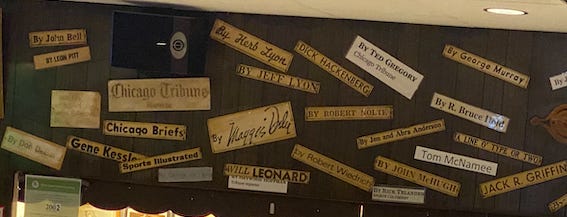
The bylines wall at the Billy Goat Tavern. Photo Credit: Author.
What Sam Kept
Sam didn’t found the Billy Goat—that was his uncle William. But Sam ran it for decades, and running it meant something specific. It meant making the place, as one longtime regular put it, an equal-opportunity establishment: prolific drinkers, wayward politicians, off-duty cops, press operators running ink-stained hands through their hair after a night shift drank side-by-side with cabbies, tradesmen, and celebrities who wanted to feel like regular people for an hour. All of them got the same beer, often poured by Sam himself.
This is what gets lost in the Belushi rendering: The Billy Goat wasn’t just a journalists’ bar. It was a neutral bar. Rival reporters from the Tribune and the Sun-Times, whose buildings flanked the tavern like opposing counsel, called truces over beers and swapped tips and arguments after deadline. Cops and beat reporters drank in the same room. Politicians and the columnists who skewered them occupied adjacent barstools. Legendary journalist Mike Royko, who held court at what Sam designated “Wise Guy’s Corner,” described the barkeep as being “like a brother.” Apparently he and many others did some of their best thinking about the city and its denizens while surrounded by Chicago contradictions and dead-serious arguments about the Cubs.
That mix—that deliberately maintained, carefully tended collision of people who might otherwise never share a room—is what social scientists call a “third place.” Not home, not work, but the informal infrastructure of the in-between. Ray Oldenburg, who coined the term, argued that third places were essential to democratic life because they leveled hierarchy. The Billy Goat was a third place with a particular genius: it collapsed the distance between the people who ran the city and the people who covered it. Everybody got the same cheezborger.
Of course, a place this great couldn’t remain a secret hideout forever. Today there are Billy Goat Tavern outposts at O’Hare, Midway, Navy Pier, the Merchandise Mart, and near the United Center, not too far from where it started. It’s a testament, really, a sign that we have good enough sense to want to multiply this third space. But are we grasping at bygone community?
The Harder Question
I keep coming back to the idea that the “original” Billy Goat Tavern has, well, outlived much of the ecosystem that created its magic.
The Chicago Sun-Times sold its building, which was demolished in 2004 to make room for Trump Tower. The Chicago Tribune sold its landmark tower in 2018. The City News Service (successor to the legendary City News Bureau, where editors commanded “If your mother says she loves you, check it out”) held its farewell party at the Billy Goat on New Year’s Eve 2005. A paperboard banner commemorating City News still hangs in the back of the Billy Goat, amended by a handwritten “correction”—a former staffer quibbling with the exact date and time of the wire service’s demise.
The reporters who used to slouch down the stairs after deadline, the ones whose bylines are still taped to the walls? They’re mostly gone, retired or laid-off or doing something else to pay rent these days.
A recent visit found the bar that once swarmed with journalists now crammed with construction workers and tourists watching YouTube clips of the SNL sketch on their phones. To be clear: this is not a complaint. Construction workers are exactly the kind of people who should be drinking at the Billy Goat, and tourists are paying customers. But the new crowd does clarify something. It’s great that the Billy Goat persists, down at the bottom of all those stairs, it’s just the community it was built to serve is changing, as communities always do.
Third places are tricky. They can survive the communities they created. The building stays. The cheeseburgers stay. The bylines stay, even though fewer visitors know what the names once meant. The institution becomes a monument to something that no longer fully exists. It’s like the Billy Goat has become a fossil of a civic ecosystem, preserved in grease and Old Style signs.
This is also, it must be said, not nothing. The Billy Goat as a monument is still the Billy Goat. The Wall of Fame is still a wall of fame, even if the journalism industry that produced it is in free-fall. There is something real and valuable about a place that holds the memory of a city’s working life, that tapes a dead reporter’s byline to the wall with a borrowed ladder when the room runs out of words for her.
But it raises questions that neighborhoods force on us all the time: What is an institution without its community? What does it mean to preserve the form when the function is fading?
May His Memory Be Eternal
Neighborhoods teach us that people die but institutions sometimes stay. This can be a form of grace: the diner that outlasts its founder, the church that outlasts its congregation, the bar that outlasts the newspaper across the street. Something of what those people built persists in the architecture, the ritual, the habit of showing up.
It can also be a kind of haunting.
In later years, Sam Sianis arrived each morning to greet customers at the top of the stairs, yell orders from the grill, and pose for photos. He was, by then, as much a monument as the bylines on the wall—a living piece of the institution’s memory, showing up every day to remind the place what it had been. When he died, he took a first-hand connection with him, a living link to a heyday animated by all those names on the wall (and the ones populating the stories they wrote).
May his memory be eternal. I was baptized Greek Orthodox but raised Catholic—16 years of Catholic school, 2 Easters a year, and a full freight of Catholic guilt and trauma. Still, I know this phrase. In the Orthodox tradition, it’s more than sentiment, it’s theology. The dead persist in the memory of the living. The community that remembers holds its dead, keeps them real.
The Billy Goat now has grapple with a question every third place eventually faces: If it’s the community that made the place, the community that keeps the memory eternal, well what happens when the community becomes something new? Can you multiply the place and cultivate new communities, can you keep up while holding on?
My father said “Cheezborger” until the end. He was proud of it — that ridiculous thread connecting his diner to a legend, a Greek line passing between Greeks, through a television set, across 30 years. That thread is thinner now. But it’s still there. And if the Billy Goat is lucky, 30 years from now someone else will be standing at that bar, proud of some connection they can’t quite name, telling a story about the place that has nothing to do with Royko or deadlines or the Cubs. A new community. A new memory. Eternal, in its own way.
The Billy Goat Tavern is at 430 N. Michigan Ave., Lower Level. Go down the stairs. Order the cheeseburger. Read the names on the wall. Then go read their stories.
Thanks AP. A real beaut. Third places can become first places. A refuge from places 1, family, and 2, work. You lived it firsthand at your family restaurant. I did too at Ricky G's on Touhy and Western. A neighborhood third place where I tended bar for several years. The community WAS the institution. The same people sat at the same seat, coming in at the same time, drinking the same drink every day. And that routine was comforting. To some, like me, it became my first place. Happy to work any holidays to get away from the dysfunction of my family, to spend time with my third-place family, who loved me unconditionally by my tip count! You mention the breakdown of hierarchy. The beauty of Rogers Park diversity on display even back then. No one was Black, Indian, Irish, or Greek. It was Tony, Hakeem, Kevin, and Joanne (and I can still picture them). And two Jews owned it, Rick and Gary!
More problems were solved in those three years too, be it auto repair, house painting, electrical work, and many, many relationships. World problems were also solved regularly with little discord. Maybe our current government leaders need to come down from their ivory towers and head to their local third place. Looking forward to the next one.
May he rest in peace. Such a huge part of Chicago culture.