

Losing Shay
The Toll of Work that Never Ends

By the time I arrived, the parking lot at Precious Blood Ministry was already full, the sidewalks clustered with people I recognized from years of this work, from conferences and community meetings and late-night calls about shootings. There was Lupe, near the entrance, his face carrying the particular weight of losing someone who had held him together through hard years. Sam, a pillar in the field with a salesman’s smile, greeted and hugged all who entered the courtyard, though he was clearly hurting. And nearby, I spotted Kelly, who works on the staff wellness team at the Institute for Nonviolence Chicago (INVC), who wore the look of someone who understood exactly what was happening — and who also knew that understanding doesn't make grief any lighter.
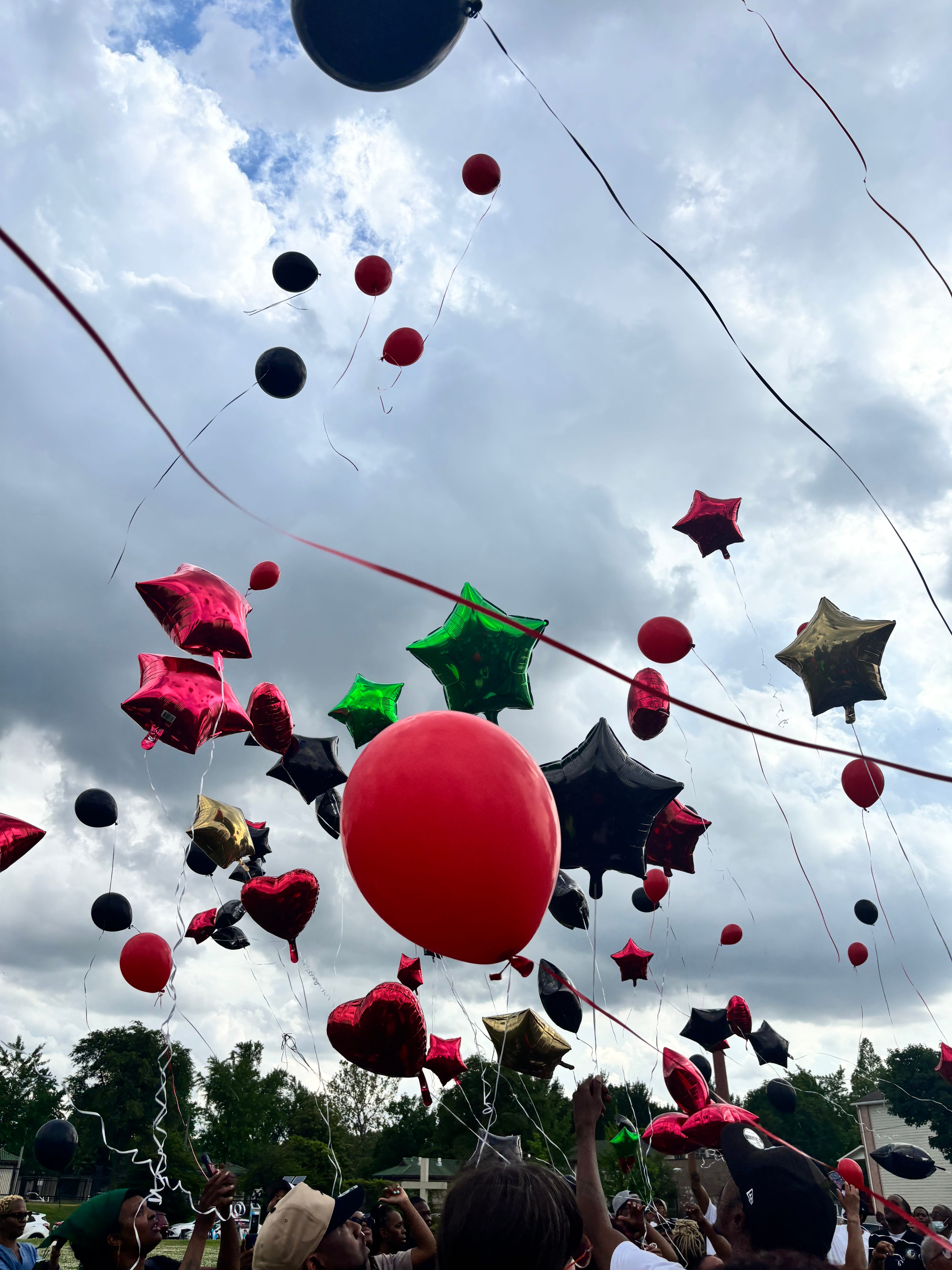
Just before 3pm, we were all ushered into a small open park beside the ministry, where someone had set up a portable amplifier and a microphone. People holding bunches of balloons passed the mic, all saying variations of the same thing: She was their sister. She was their auntie. She looked out for them. She looked out for their kids. She looked out for their neighborhood and its peacekeepers.
Her name was Tera Genous. Everyone called her Shay. A 53-year-old outreach supervisor at INVC, Shay died in her sleep on a Sunday night, of natural causes, though the people who loved her will tell you that “natural causes” is a complicated phrase. This was a woman who had been at the hospital until 4am just days before, sitting with families after a shooting. She had buried her own son just a few years ago. She had spent her whole life taking care of others.
Holding the mic, one person said Shay died because she was exhausted from the work. INVC’s CEO, Teny Gross, described it as not just exhaustion but the accumulated weight of showing up, every day, for people in crisis, in a community that has been absorbing trauma for generations.
There were maybe a hundred people in that park, many jostling for a few inches of shade as the afternoon heat reminded them they’d forgotten a hat or sunscreen. People started talking among themselves before the service was over, because that’s how grief works sometimes—loud and present and unwilling to wait its turn. Someone said a prayer. The balloons went up.
Chicago is famously flat. From Back of the Yards, on a clear day, you can watch a hundred balloons climb until they clear the rooflines, then the three-flats, then further still, scattering as they go. What was a cluster becomes a constellation.
The next day, most of us would assemble again, this time for the ten-year celebration of community violence intervention (CVI), the field to which Shay Knox had dedicated, and ultimately given, her life.
What a Decade Means
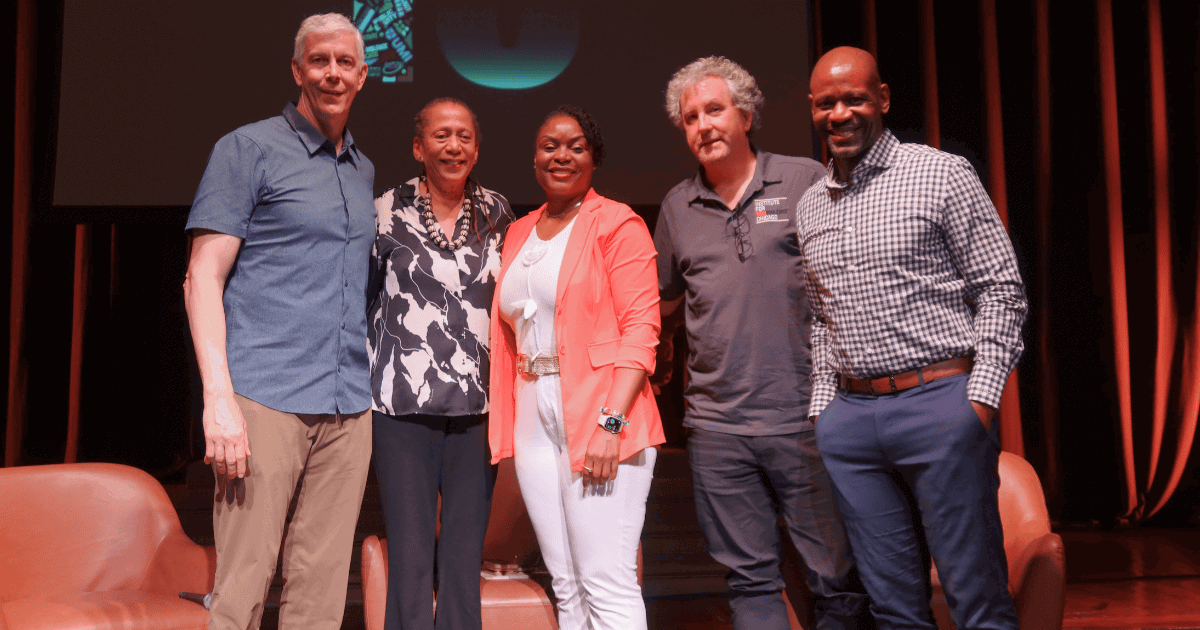
There was a DJ. There was food. There was a maker’s fair with tables showing off the programs and partnerships the field had built. Job training, behavioral health, community organizing, reentry services, all of it was laid out like proof of a decade’s toil, of doing the kinds of infrastructure work that doesn’t usually get a party. There were panels and small sessions, people trading lessons learned. There were smiles and long hugs between people who had spent years in the trenches together. For one evening, the people in the room were simply being asked to celebrate what they’d built.
What they were celebrating wasn’t any single organization but a whole ecosystem that, ten years prior, was barely a coherent “thing.” INVC, where Shay worked, was one of roughly a dozen organizations that, with the backing of private philanthropy and growing recognition from government, had built a professional, civilian infrastructure for public safety—something Chicago’s neighborhoods had long needed and rarely received (see the previous post on CVI’s “Invisible Infrastructure”).
If you study the history of this field, you know its rhythm. Funding arrives. Politicians credit the work during the good years, then defund it during the bad ones, sending the workers—the ones with the street credibility and the 4am hospital runs—back to precarity and poverty. But something had happened differently this time. The funding allowed organizations to operate year-round, pay their workers’ salaries, offer benefits, and build toward something lasting. Philanthropy led, then local and state governments followed. Eventually, the Biden White House recognized the work, and the federal Bipartisan Safer Communities Act put $250 million into CVI programming.
The pandemic, and the gun violence surge that followed, didn’t scatter Chicago’s CVI field—it forged it. When the crisis hit hardest, organizations that had been competing for the same grant dollars found themselves at the same table, not because they suddenly agreed on everything, but because the alternative was watching their communities drown.
The core of it, though, has always been the workers themselves. The field stopped apologizing for hiring people with criminal records and, instead, started calling them what they were: experts. The collapsing of distance from church basements to the governor’s office recognized at that celebration evidenced a decade of insisting that the people closest to the problem are best positioned to solve it. None of it happened by accident.
What got built
Today’s CVI organizations are not violence prevention programs in any narrow sense. They are neighborhood employers, food and school supply distribution networks, escorts through volatile blocks, and crisis support for grieving families. They are the people who show up—at the hospital, at the front door, at the kitchen table—when formal institutions won’t or can’t.
There’s a saying among those who do this work: “the street is always there.” One reason many young people turn to their crews, no matter the cost, is because the street is always present, always available, no matter what they’ve done or what they’re going through. Outreach workers like Shay take the same approach. They will be there—no matter the time, no matter the toll.
And the toll is real, documented, measured, impossible to dismiss. We’re not talking about abstract risks, but the baseline conditions of the work.
In a near-census survey of Chicago’s outreach workers that my colleagues and I conducted, we found that nearly 60% had witnessed a shooting while on the job, and 1 in 5 had been shot at themselves. More than half had experienced the death of a client due to violence. And the psychological weight compounds the physical danger: 94% of outreach workers reported experiencing at least 1 symptom of secondary traumatic stress (STS) in the prior week alone. Trouble sleeping. Emotional numbness. Reliving clients’ trauma as if it were their own. The workers who had lost a client to violence carried the heaviest burden: their STS scores were significantly higher, perhaps because what they were left to process wasn’t just trauma but absence, the sudden disappearance of someone they had built a relationship with over months or years.
One statistic really stands out: on a per-year basis, outreach workers get shot at 10 times as often as Chicago’s police officers. We give police officers line-of-duty recognition and public funerals. We give outreach workers a balloon release, when we give them anything at all.
Shay wasn’t interrupting a conflict when she died. But hours before, she had been sitting with a family in the worst moment of their lives, representing an organization and a field and a city that had made them a promise. She was doing what no statistic captures: she was holding the line.
Academics and policymakers and CVI workers themselves have spent years debating whether CVI works. The question is far too narrow for what is, in truth, expansive work that extends beyond counting bullets. We measure success in shootings—up or down, this year versus last—as if the whole project of community safety can be reduced to a number on a crime report. What Shay was doing in that hospital wasn’t just violence prevention. She was reinscribing the infrastructure of a neighborhood that had decided to take care of its own.
I think about how we have built other kinds of safety infrastructure in this country. The first fire brigades weren’t departments, just neighbors with buckets. Then they were organized, funded, professionalized—given instruments and institutions and a pension and a funeral if they died in the line of duty. Today, nobody stands outside a burning building asking whether fire departments work.
CVI is on that arc. What matters at the ten-year mark is that this infrastructure is civilian. That’s not a limitation—that’s the point. CVI reaches places and people that police can’t reach and does work police probably shouldn’t try. Its credibility is inseparable from its independence. As it is organized, funded, and professionalized, it earns the thing the fire department and other essential services already have: the right to be treated as essential, not experimental.
What Shay and hundreds of other peacemakers have built over this last decade is not a program, but the connective tissue, the fascia of community safety. The presence of CVI workers can be the difference between a neighborhood that absorbs a mass shooting and spirals, and one that absorbs it and holds the line.
The Brief Party
The people at that anniversary celebration knew what I knew: if a shooting happened that night, someone in the room would leave. Not reluctantly. Not after deliberating. They would just go—the way Shay went to the hospital at midnight, the way outreach workers have always gone—because that’s the job. The party is a brief moment of joy. The work is the rest of it.
The day after Shay died, there was a shooting on the West Side. Some of the victims were connected to her organization’s participants. Her colleagues didn’t miss a beat. They were in the streets before the night was over, doing the thing the field exists to do. They were there before the headlines, and they’ll be there after they move on.
Chicago’s CVI ecosystem exists. That’s what the ten-year mark means. We don’t have to search for it. We just have to support it and give it the time and stability to keep going—even as the federal government retreats, even as the political winds shift, even as the field loses people like Shay to the weight of the work.
The balloons went up on a hot Tuesday afternoon in Back of the Yards, black and red against a shockingly blue Chicago sky. The next morning, Shay’s colleagues put on their good clothes and went to the anniversary party. The morning after that, they went back to work.
That’s the ten-year story. Not a victory lap. A testament to resilience and community, to a cluster that’s become a constellation.
Further Reading
If you want a deeper look at the costs this piece describes, our research team’s findings on the risks and exposure outreach workers face on the job are summarized in Scientific American; the original studies can be found here and here.
For a longer, more academic take on the history and current moment of the field, read, Re-Centering the Community in Violence Intervention,” Annual Review of Criminology.
For a closer look at the celebration itself—the panels, the live podcast tapings, the wellness stations and makers’ market—Metropolitan Peace Initiatives has a full recap of “The Art of Peace: 10-Year CVI Anniversary Celebration & Expo.”
To learn more about the Institute for Nonviolence Chicago and the work Shay gave her life to, visit nonviolencechicago.org.
May Shay rest in peace. Sounds like an amazing organization.
Very nice tribute and keenly centered on the larger meaning. 🩷